









How I built my personal website with AI in 10 hours: Windows 95, GEO and zero lines of code
Translated from Russian. Prices are in Kazakhstani tenge (₸).
In short
I built this website myself, with no designer or developer, together with Claude. It took about ten hours of my time and 10,000 tenge for the domain; hosting is free. The longest part was finding the look: I spent hours cycling through options in ChatGPT until I found a reference, and Claude turned it into a Windows 95 desktop. The site is an experiment: I want AI assistants to answer “content strategist in Kazakhstan” with, among others, me. And yes, there are more Easter eggs here than in Shrek.
Why a content strategist needs a personal website
We didn't escape the GEO trend either — optimizing for the answers of AI systems. While preparing a new offer for clients for next year, I thought it would be good if people could find us too. Right now TELLER barely shows up in search.
Redoing the agency website isn't the right move just now. If we do it, it'll be a big one: with our media, GEO articles and case studies from every country. Besides, storyteller.kz is built on Tilda, and adding articles there by hand every time is simply inconvenient.
And one more thing: the market currently knows me better than it knows TELLER as a company. So the idea was to make my personal website the top of the agency's funnel. Someone finds me through AI search and gets a consultation from me personally. And if they need a team, they come to the agency as a client. Good all round, it seems.
→
The look: the longest part
I sketched the site structure quickly. The visuals, though, were painful. Without a designer's hand, AI-made websites look garish and instantly recognizable: there's already a whole genre of the “AI website”, and I wanted to get away from it. It mattered to me to make something I could be proud of. Otherwise better not to do it at all.
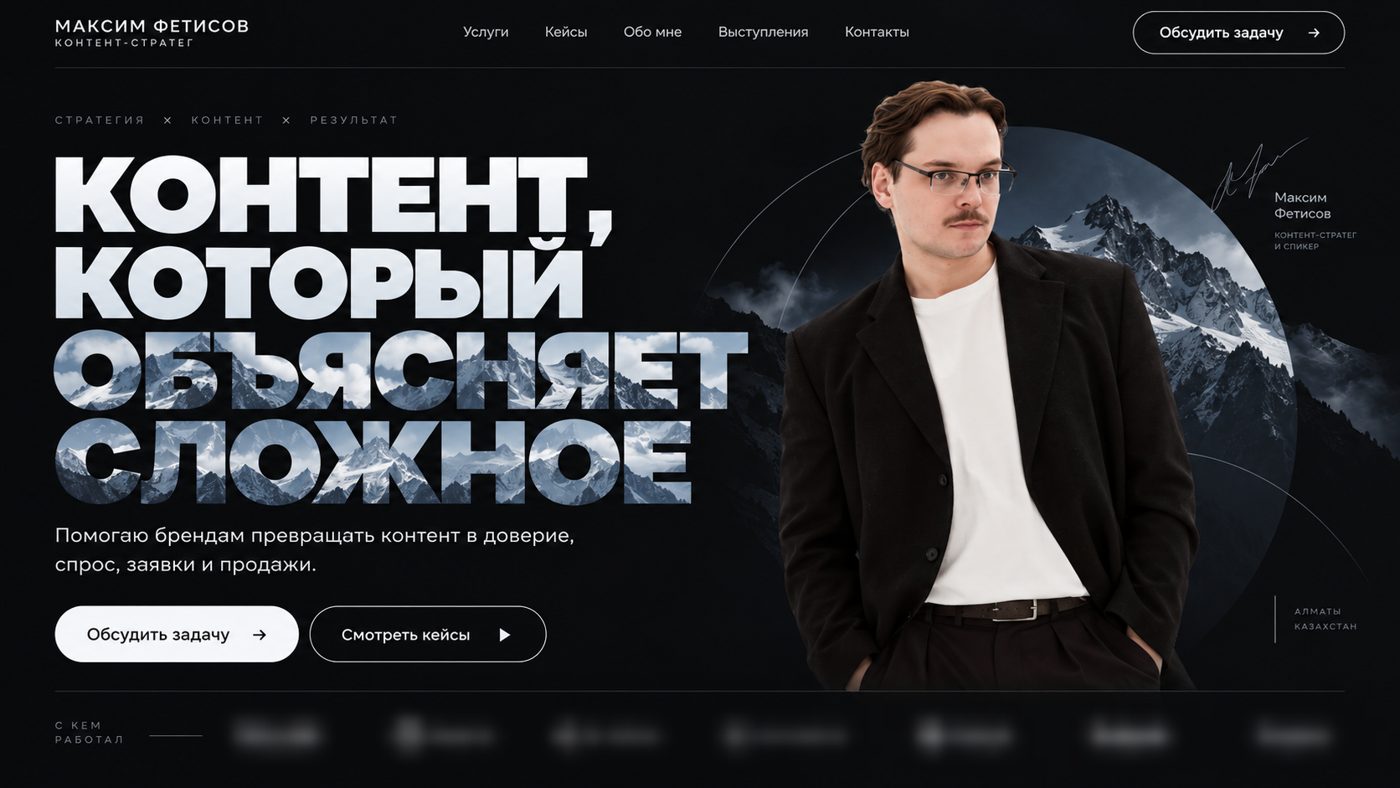
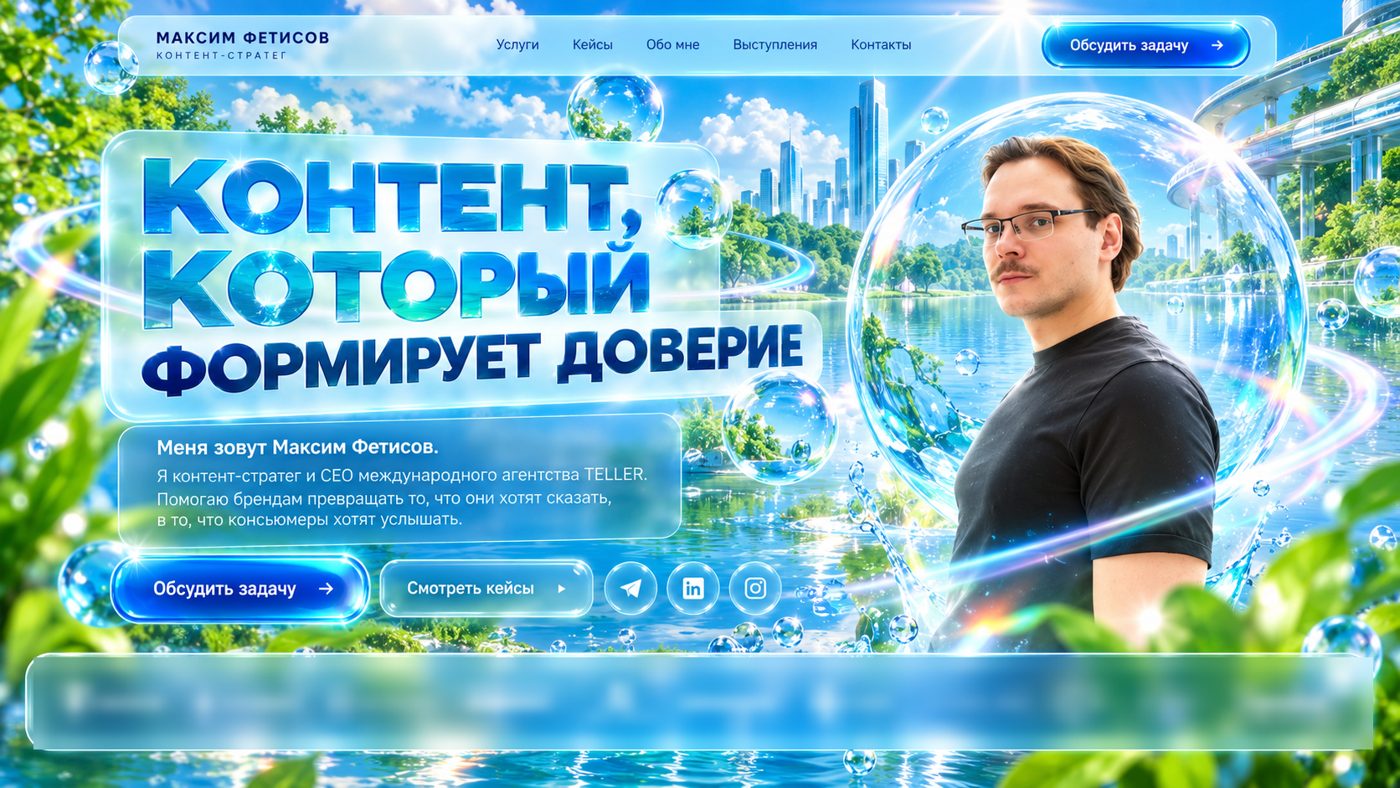
I spent a long time trying options in ChatGPT. I started with a black background and mountains, then moved on to the Frutiger Aero look with bubbles and glass. Nothing clicked. For this task ChatGPT works like a “random” button: you keep pressing until it accidentally puts together something that hooks you.
Then I went to Pinterest, looked at pictures I liked, and somehow ended up at old web design. I loaded references into ChatGPT, and after three to six iterations it produced an image where I realized: this is it. The search took two or three hours.
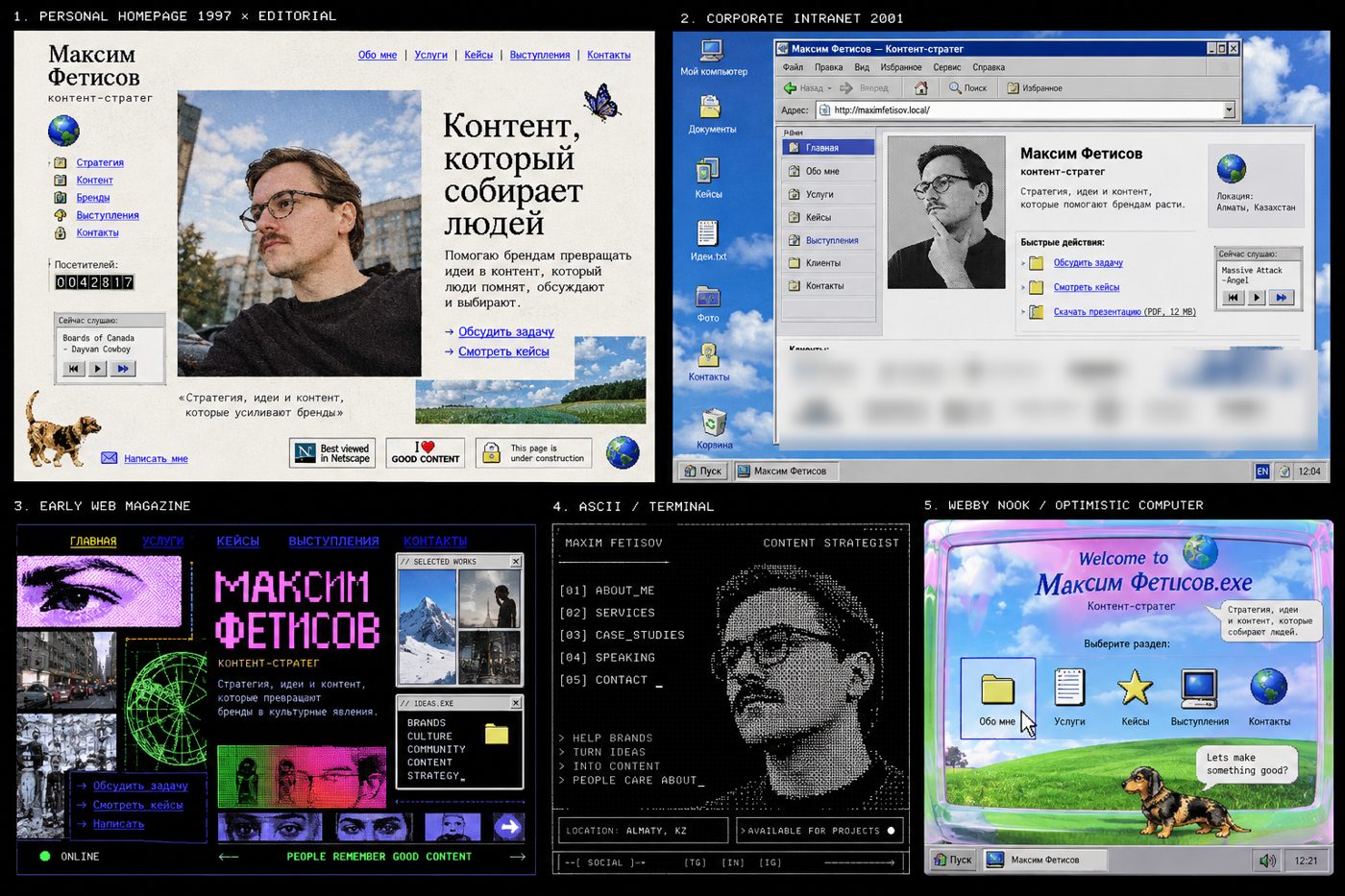
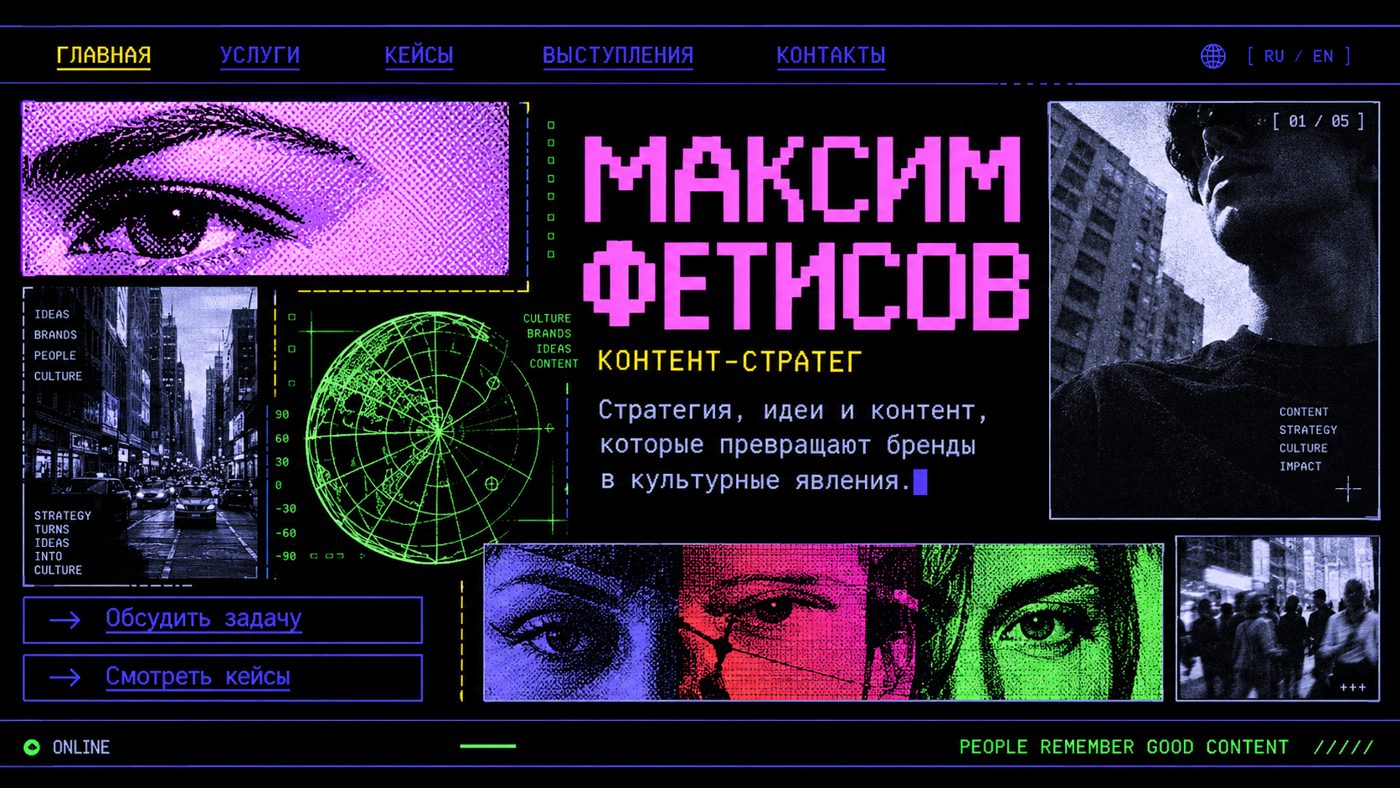
I gave the image to Claude, and it picked it up beautifully. In fact, Windows 95 was more its idea than mine. I gave it a magazine-style mockup, and it unfolded it into a whole desktop: with windows, a Recycle Bin and a Start button. I liked it immediately. From there we kept polishing until the final version.
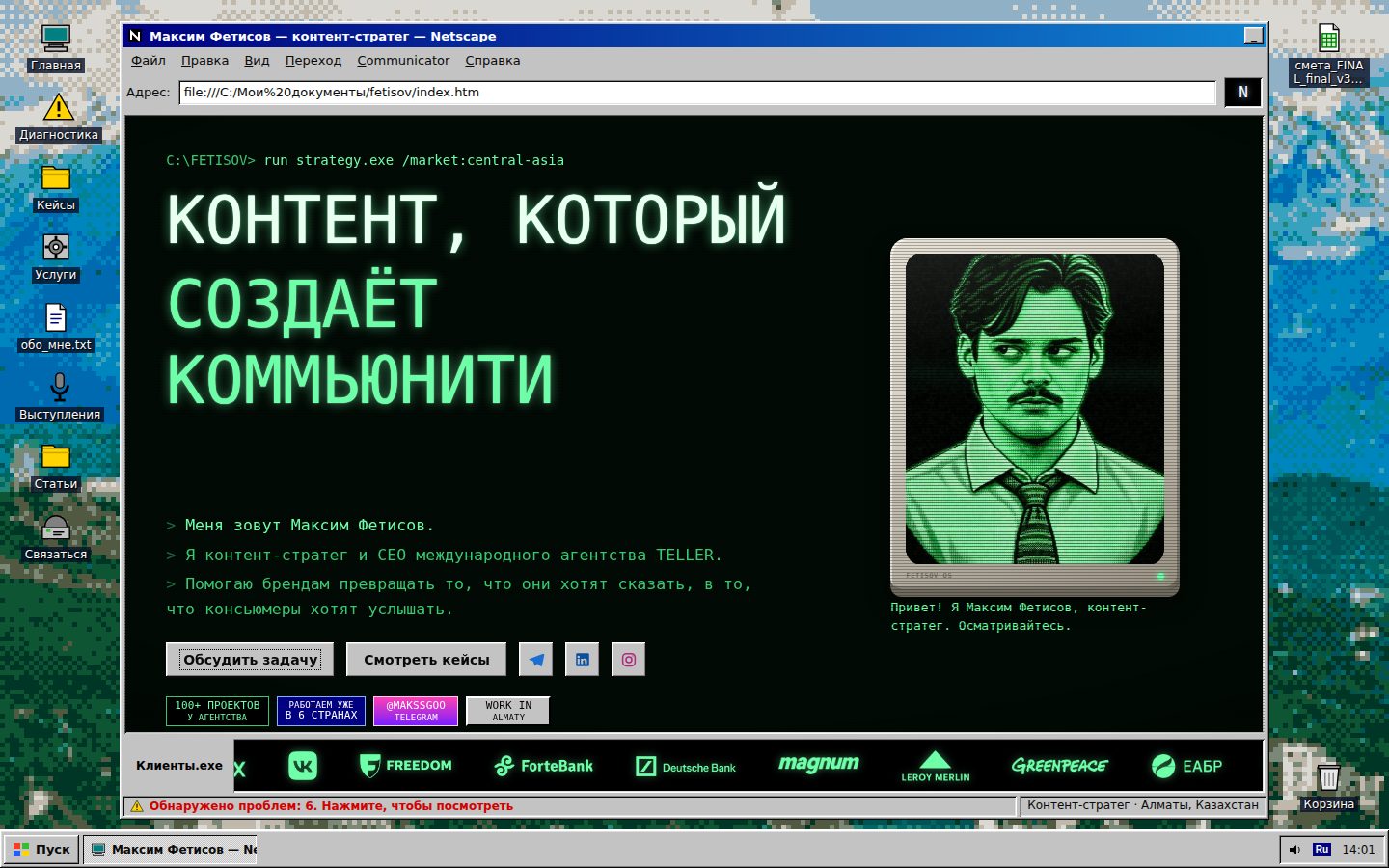
How the build went
About two weeks passed from idea to launch. But almost all of that time I was stuck on the visuals: I'd start, not like it, put it aside, and I had little time. Then I decided to crank it out in one evening. I found the look, filled the site with graphics in that style, and there was no stopping me.
The longest session was about five hours of vibe coding in a row. In total the site took about ten hours of my time.
I had never built websites myself before. When I worked in project management, I wrote specs and led development teams, so web development as a discipline is familiar to me. But I'd never coded: there were some attempts long ago, but they didn't go anywhere.
I'd call my role here that of a conductor. Content strategy work and a fairly hands-on career give me a view from every side: visuals, copy, structure and optimization so the site gets indexed well. Claude wrote all the code, while I set the tasks, made the decisions and gave the edits.
I didn't even consider Tilda, WordPress or a freelancer. I wanted to do it myself.
What struck me most was how much you can actually build. Every idea that came to mind turned out to be doable. Web design isn't my specialty, and I was amazed at how easy it really is.
Easter eggs: more than in Shrek
I wanted to pack the site with as much retro aesthetic and nostalgia as possible. Here are my favorite details:
- A terminal with my face. The home page has an old monitor with my portrait, like Mr. House from Fallout: New Vegas. It blinks, follows the cursor with its eyes and reacts to what you do on the site: frowns at Diagnostics, winks at the estimate, gets thoughtful on the articles. And if you keep poking it in the face, it gets angry.
- Screensaver. If you don't touch the mouse for a minute, my head starts bouncing around the screen. That was my idea.
- Masik and Chechik. Right-click the desktop and choose New: you'll find Masik, Chechik, Shtrikh and Tyubik. It's a meme I came up with.
- The estimate. In estimate_FINAL_final_v3_APPROVED.xls, one of the line items is a vintage tie for the pitch. That one's personal.
- Recycle Bin. Try emptying it: the file content_for_contents_sake.txt is being used by other agencies.
- Shut down. You can turn the computer off. And whoever remembers the code from old games will see a blue screen.
- Modem. The Contact button dials me up over dial-up, with sound.
- Media player. Click the speaker in the tray and 8-bit music starts playing.
- Diagnostics. A cascade of strategy.exe errors with that classic old Windows sound. Each error is a problem clients come to me with, plus how to fix it.
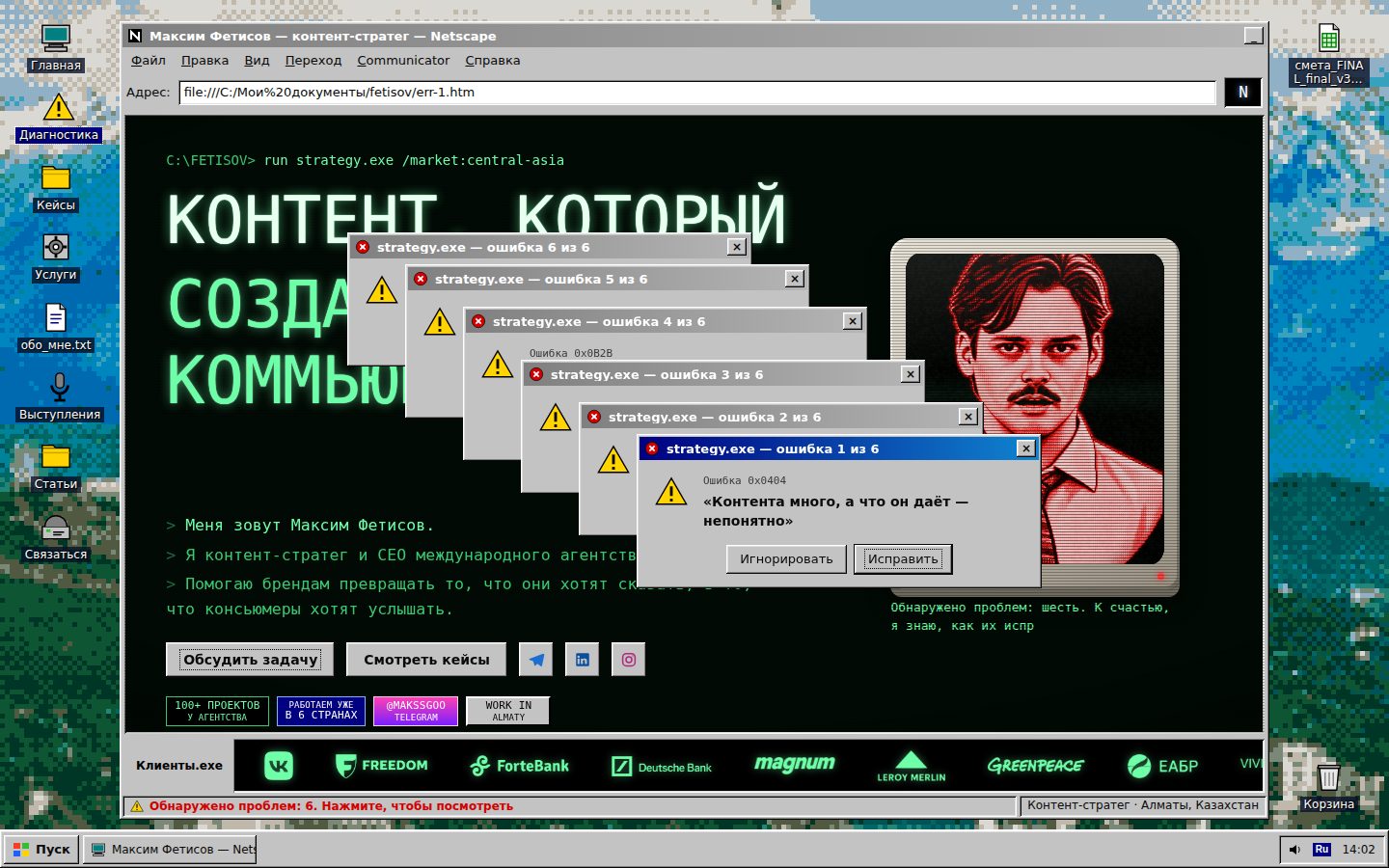

The hardest part was knowing when to stop. On one hand, I didn't want to overload the site: there's a focus of attention I want to hold and direct. On the other, when you realize how wide your options are, it's hard to hold back. Forgive a beginner coder's naivety, but it felt like a magic wand.
How the site is built for AI search
The site is a GEO experiment, so under the hood there are things visitors don't see:
- Every window has its own address. Case studies, articles and services open at separate URLs, and search engines index them as separate pages. Yet the page doesn't reload, and the music in the player doesn't stop.
- schema.org structured data: who I am and where I work, articles with an author and date, a Q&A section.
- An llms.txt file with a short description of the site for language models, a sitemap and RSS.
- An English version of the whole site, articles included.
- Google Analytics, Google Search Console and Yandex Webmaster.
I deliberately didn't make a Kazakh version. Good Kazakh is expensive, and right now I'm not ready to budget for it. I decided it's better to have none than to have one just for show. Maybe I'm wrong, but it's honest.
→
Articles from interviews
All the articles on the site, including this one, are written by AI from my interviews. Claude sends questions, I answer, and it writes the text in my voice and checks facts against sources. One article takes me 5–10 minutes. I try to give more information than needed: my experience, expertise, and the occasional joke.
To be honest, I didn't do keyword research. We chose topics together with the AI, based on what people might ask. The goal is for AI to recommend me, among others, for “content marketing” and “content strategist”. I don't expect results before December or January.
Where it got hard
Most of the manual work came at the very end, once the site was ready: buying the domain, connecting hosting, Google Analytics and the webmaster tools. Nothing difficult, but sitting in a chat writing edits to the poor artificial intelligence was much easier. The longest wait was for the HTTPS certificate — more on that below.
The only real frustration was at the visuals stage I described above.
How to launch a site like this: step by step
If you want to do the same, here's what I had to set up once the site was ready. Claude walked me through it with screenshots; it took two evenings.
- Domain. I bought maksimfetisov.com from the Kazakhstani registrar PS.kz for about ₸10,000 a year. Two easy-to-miss things: confirm the owner's email right away (for .com you have 15 days, or the domain gets suspended), and check that you're listed as the owner.
- Code on GitHub. All the site files live in a private repository. When Claude changes something, it pushes the changes there and the site updates itself.
- Hosting on Netlify. The free plan connects to GitHub in a couple of clicks. My first deploy failed because of one stray setting; Claude found it in the log.
- DNS. At PS.kz I switched the nameservers to Netlify's, and from then on Netlify manages all the domain records.
- HTTPS certificate. Netlify issues one for free through Let's Encrypt, usually within minutes. Mine got stuck for more than a day, and the site showed “Not secure”. What fixed it: removing the domain from the site settings in Netlify and adding it straight back. The certificate was issued a couple of minutes later.
- Google Search Console. I verified the domain with a TXT record in DNS, submitted the sitemap and requested indexing for the main pages.
- Yandex Webmaster. Verified with a file on the site, added the sitemap and submitted pages for recrawling.
- Bing Webmaster Tools. The step many people skip. ChatGPT search relies heavily on Bing's index, so for GEO it matters more than you'd think. It connects in a minute by importing from Google Search Console, and the AI Performance section shows how often Bing's AI cites the site.
- Google Analytics. Clicks on Telegram and email count as leads, so I can see where the people who message me come from.
What it cost
| Item | Cost |
|---|---|
| My time | about 10 hours |
| maksimfetisov.com domain (PS.kz) | about ₸10,000 |
| Hosting (Netlify) | free |
| Code storage (GitHub) | free |
| Designer and developer | not needed |
How it turned out
Everyone I've shown the site to said it's cool and impressive. Some expressed their admiration in unprintable terms. And the person whose opinion matters most to me, my wife, said she'd never seen a personal website this cool.
I wouldn't do anything differently. Usually it's one or the other: either the result is good and the process is torture, or the process is fun and the result is so-so. Here I got both: I made exactly what I wanted and had a blast doing it. Next I'll keep adding articles and maybe new Easter eggs.
Key points
- An expert's personal website can work as the top of an agency's funnel.
- With AI you can build a site without a designer or developer: it took me about 10 hours and 10,000 tenge for the domain.
- The hardest part is the look. Without a trained eye, AI produces recognizably “AI” design, so look for references until you say “this is it”.
- The human's role is the conductor: vision, decisions, edits. The AI writes the code.
- For GEO, what's under the hood matters: separate page addresses, markup, articles that answer real questions.
- Articles from interviews save time: 5–10 minutes per piece.
- After launch, connect not only Google and Yandex but also Bing Webmaster Tools: ChatGPT search relies on its index.
Want AI to know about your brand? Message me on Telegram at @maximfetisov: we'll see what ChatGPT already knows about you and draw up a plan. The format and price of a consultation are on the Services page.